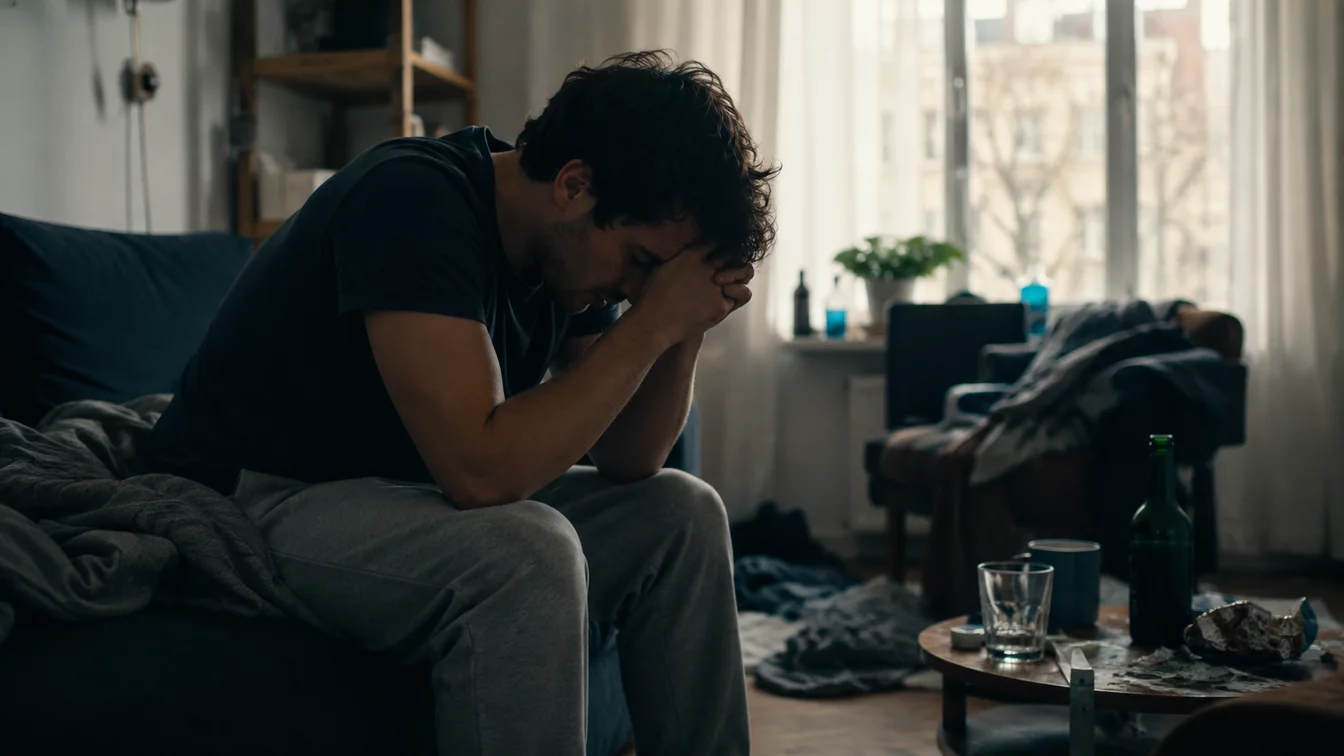
Hangxiety: Why You Feel Anxious the Day After Drinking
Written by Jakub Havelka
Software engineer · 10+ years in recovery · Author of the Craving Toolkit
You wake at 4 AM with your heart pounding. The sheets feel wrong. Your phone is face down on the nightstand and you cannot bring yourself to check it. Something is wrong, but you cannot remember what. Then you do remember: you drank last night.
This is hangxiety. Not a hangover in the headache-and-nausea sense — something worse. A dread that has no object. A guilt that exceeds anything you actually did. A sense that you have ruined something, even if nothing happened.
If you are reading this in the middle of one, the first thing to know is that this state is chemical and time-limited. It will pass. It is not the truth about your life. It is your nervous system rebounding.
What is hangxiety, actually?
Hangxiety is the anxiety, dread, and emotional fragility you feel the day after drinking — distinct from the physical symptoms of a hangover, though it usually rides alongside them.
The mechanism is a rebound. Alcohol is a central nervous system depressant. While you are drinking, it enhances GABA — the brain's main inhibitory neurotransmitter, the one that calms you down — and suppresses glutamate, the main excitatory one. That's the part you feel as relaxation, loosening, social ease.
Then your brain notices the imbalance and pushes back. As alcohol clears, GABA activity drops and glutamate surges. Your nervous system, which was artificially sedated, swings to the opposite end — overstimulated, hypervigilant, primed for threat. The next morning you wake up not just neutral, but in a state of chemical agitation.
Layer on top of that: disrupted sleep architecture (alcohol crushes REM), low blood sugar, dehydration, elevated cortisol, and the half-remembered fragments of last night. The result is a body that feels like it is being chased and a mind that is searching for the reason.
Your mind will find a reason. It always does. That text you sent. That thing you said. That look someone gave you. Hangxiety is a state in search of a story, and the story it picks is rarely accurate.
The dread is real. The narrative is not.
Why does it feel worse the more you drink?
There is a cruel asymmetry to drinking and recovery: the more often you drink, the bigger the rebound tends to get.
Anna Lembke, in Dopamine Nation, describes pleasure and pain as opposite sides of a balance. Every drink tips the balance toward pleasure; the brain responds by pushing the other side down harder. Over time, with repeated tipping, the balance does not return to neutral. It settles into a tilted resting state — leaning toward pain, anxiety, and low mood, even on sober days. Hangxiety is what that tilt looks like in acute form, after a recent binge.
This is also why people with existing anxiety disorders tend to experience hangxiety more intensely. Their baseline nervous system is already running hot. Alcohol's sedative effect feels disproportionately good — and the rebound feels disproportionately bad. The next morning's anxiety is not just hangxiety. It is hangxiety stacked on top of the anxiety you were already drinking to escape.
Which creates the trap.
You drank because you were anxious. You wake up more anxious than before. The fastest known way to relieve that anxiety is another drink. So you have one. The rebound the next day is bigger. The drink to fix it is bigger. The loop tightens.
This is one of the cleanest pathways into alcohol use disorder, and almost nobody who is in it can see it from the inside.
What actually helps in the next few hours?
You are not going to think your way out of a neurochemical rebound. But you can shorten it, and you can keep yourself from making it worse.
Eat something, even if you don't want to. Low blood sugar amplifies anxiety symptoms — the racing heart, the shakiness, the sense of impending doom — and your body is depleted. Something with protein and complex carbs will move the needle faster than coffee, which mostly makes things sharper.
Hydrate, but skip the second espresso. Caffeine on top of a glutamate rebound is the chemical equivalent of pouring gasoline on the fire. Water, electrolytes, and a single mild coffee if you must — that is the ceiling.
Move your body gently. A walk, ideally outside. Not a workout. The goal is not to sweat it out (you can't), but to discharge some of the stress chemistry through movement and downshift your nervous system through rhythm and daylight.
Do not relitigate last night yet. Your brain is going to want to autopsy every interaction from the night before. Do not let it. The narrative your mind generates in this state is unreliable. Wait until tomorrow, when your chemistry is closer to baseline, to decide whether anything actually needs addressing.
Use a calming practice you already know. This is not the time to learn meditation. But if you have a breath practice, a body scan, or a meditation routine you've already built, use it. The point is not to feel good. The point is to remind your nervous system that you are not, in fact, under attack.
Do not drink again. The "hair of the dog" works because it delays the rebound — it does not eliminate it. You are borrowing from tomorrow at a brutal interest rate.
The state will pass. Usually within a day, sometimes longer after a heavy session. What you do during the wait determines whether you spend the next morning here again.
Is hangxiety a signal worth listening to?
Most articles about hangxiety treat it as a nuisance to be managed. I want to suggest something different.
Hangxiety is your body telling you something accurate. Not the content of the dread — the dread itself is chemical noise. But the fact that you are experiencing it, repeatedly, after drinking, is data. It is your nervous system saying: this substance is no longer giving me what it used to. The cost is now larger than the benefit. I am paying for last night, and the interest is compounding.
People who quit drinking almost universally cite hangxiety, not hangovers, as the breaking point. The headache you can metabolize. The shame loop, the 4 AM dread, the inability to be alone with your own mind the morning after — that is what people get tired of. That is what makes them stop.
If you are at that point, you are not weak. You are paying attention.
The relief on the other side of quitting is not just the absence of hangxiety. It is the slow return of a stable mood floor — the thing alcohol borrowed against and then defaulted on. You may have to walk through a stretch of boredom and flatness as your dopamine system recalibrates, and learning to sit with empty time is its own skill. But the dread mornings stop. The phone stops being terrifying. The morning is yours again.
If you suspect your drinking has progressed beyond hangxiety into dependence — daily use, withdrawal symptoms, drinking to function — please call SAMHSA's National Helpline at 1-800-662-4357. It is free, confidential, and available 24/7. Alcohol withdrawal is one of the few substance withdrawals that can be medically dangerous, and you should not white-knuckle it alone.
You are not weak. You are paying for borrowed calm.
Sources
- Lembke A. Dopamine Nation: Finding Balance in the Age of Indulgence. Dutton, 2021. - Alcohol and Drug Foundation. "What is hangxiety?" adf.org.au. - Cleveland Clinic. "Hangxiety: Why You Feel So Anxious the Day After Drinking." health.clevelandclinic.org. - SAMHSA National Helpline. 1-800-662-HELP (4357). samhsa.gov.
The Craving Toolkit includes a Craving Log and Emergency Card designed to help you intercept the drink-to-relieve-anxiety loop before the next morning starts the cycle again.
Frequently Asked Questions
- How long does hangxiety last?
- Most people feel hangxiety lift within roughly a day, though heavy sessions can stretch it longer. The intensity tends to peak in the morning and gradually fade as your nervous system rebalances. Eating, hydrating, moving gently, and avoiding more alcohol or excessive caffeine will shorten the curve.
- Why do I get hangxiety after only a few drinks?
- Sensitivity varies. People with existing anxiety, poor sleep, low body weight, or a hot baseline nervous system tend to feel the rebound disproportionately, even after moderate drinking. Genetics, medications, and how recently you last drank all factor in. The amount that triggers hangxiety is not a measure of toughness.
- Can hangxiety be a sign of an alcohol problem?
- Repeated hangxiety after drinking is a meaningful signal. It does not automatically mean alcohol use disorder, but the loop it creates — drinking to relieve anxiety, then waking up more anxious — is one of the cleanest pathways into dependence. If the pattern is recurring, take it seriously.
- Will hangxiety go away if I quit drinking?
- Yes — the acute episodes stop entirely. The deeper recalibration takes longer; your nervous system may run hot for weeks as it returns to baseline. Most people report that their general anxiety level drops below where it was during drinking days, often within a few months of consistent sobriety.
- Is hair of the dog a safe way to stop hangxiety?
- No. Drinking again briefly delays the rebound by re-suppressing your nervous system, but the underlying neurochemical debt grows. You are borrowing from tomorrow at a higher rate. For frequent drinkers, hair-of-the-dog is one of the most reliable accelerators of dependence. If you cannot get through the morning without it, seek help.