ADHD and Addiction: Why They Travel Together
Written by Jakub Havelka
Software engineer · 10+ years in recovery · Author of the Craving Toolkit
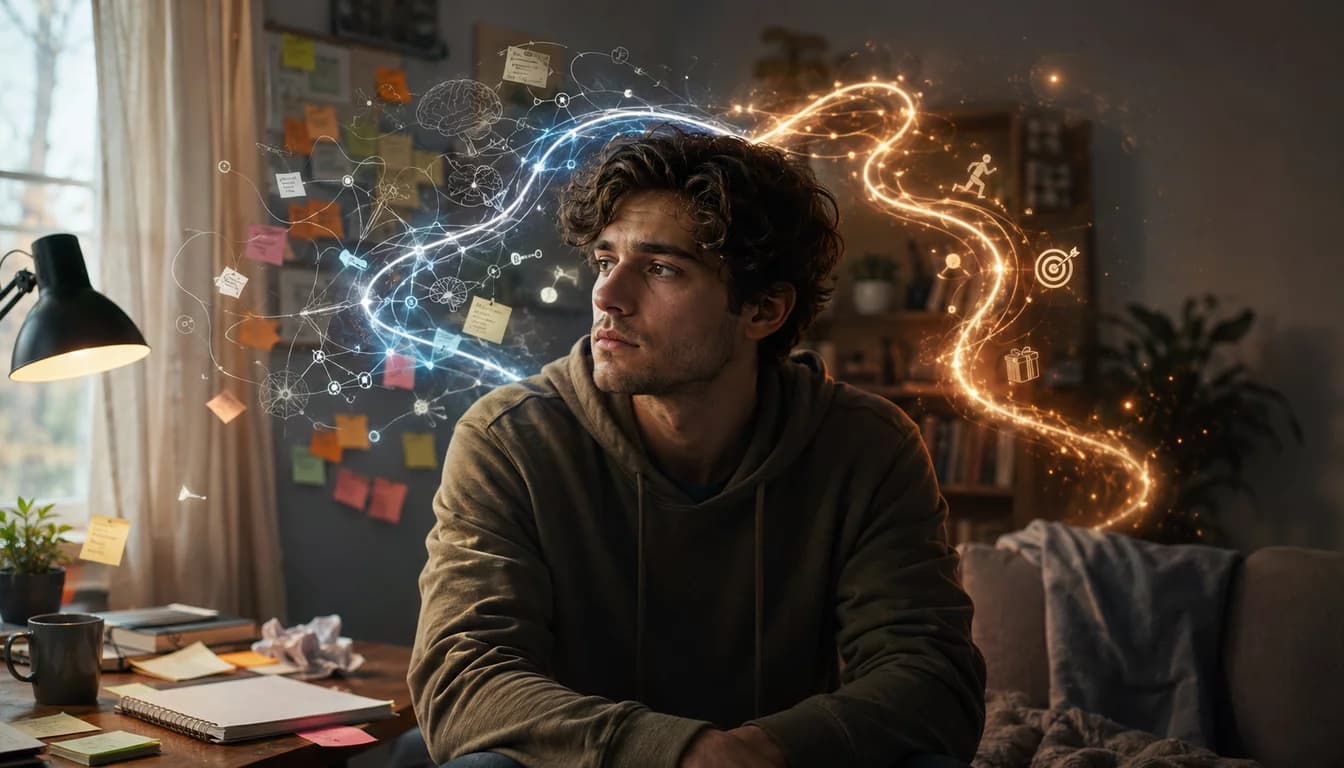
You can't sit still. Your laptop has eleven tabs open and you've been touching none of them for forty minutes. You've checked your phone three times since starting this sentence. Your skin is humming with a low-grade restlessness you can't quite name. And the thought that arrives next—the drink, the scroll, the snack, the pill, the dose—doesn't feel like a craving. It feels like the only thing in the room making sense.
If this is your default state, you may not just have an addiction. You may also have ADHD.
And the two conditions are not coincidences sitting next to each other. They share a neurobiology, share a personality profile, and feed each other in ways most treatment programs don't address.
Why do ADHD and addiction travel together?
Gabor Maté, who wrote both Scattered Minds (about his own ADHD) and In the Realm of Hungry Ghosts (about addiction), puts the connection bluntly: ADHD and addiction "have much in common, both in their characteristics and in their neurobiology. They are both disorders of self-regulation."
Look at the personality traits Maté lists for each. Poor self-regulation. Deficient impulse control. A constant need to find distractions from distressing internal states. Difficulty differentiating one feeling from another. Now ask which condition that describes. The honest answer is both, and that's the point.
The ADHD brain is not lazy. It's not undisciplined. It's a brain whose default operating system runs on under-stimulation and intolerance for stillness. Boredom registers as physical pain. Routine feels like suffocation. Internal quiet feels like menace. The brain is constantly hunting for something—anything—that will give it a sense of engagement, traction, presence.
Addiction delivers that. Every time.
What does the ADHD brain look like in addiction?
The dopamine angle is where the two conditions overlap most tightly. Maté cites work by Nora Volkow and colleagues showing depressed dopamine activity in the caudate—part of the brain's reward and motor-coordination system—in adults with ADHD. That is the same baseline deficit that makes addictive substances and behaviors feel disproportionately rewarding to people in active addiction.
When your reward system is already running quiet, the things that boost it—alcohol, stimulants, sugar, screens, sex, gambling—don't feel like luxuries. They feel like medicine. They are, in a real sense, the only thing in the room speaking your brain's native language.
That is why ADHD medications themselves are stimulants. Methylphenidate (Ritalin, Concerta) and amphetamines (Dexedrine, Adderall) work by raising dopamine activity in the same circuits where the deficit lives. The pharmacology is not subtle: doctors are treating ADHD by carefully delivering, in measured doses, a chemical relative of the very drugs that, in different form and dosing, devastate people on the street.
This is not a contradiction. It is the same biology approached from opposite ends.
Why does self-medication make sense (and backfire)?
If you have undiagnosed ADHD, you are not waiting around for a prescription. Your brain is already medicating itself. It is just doing it with whatever is available.
This is what Maté means when he writes that "people with ADHD are predisposed to self-medicate." The internal state—restlessness, inattention, emotional flooding, the unbearable static between tasks—drives a search for relief. Alcohol provides an off-switch. Cannabis turns the volume knob down. Food and sugar deliver the same fast dopamine hit on the same circuit. Cocaine and meth, paradoxically, often calm the ADHD brain rather than rev it up—doing for it, briefly and brutally, what a careful prescription does at controlled doses. The effect is recognizable. The cost is not.
It is why a person whose life looks chaotic on every dimension can become eerily organized for the few hours after they use. The drug is doing for them what their brain cannot do on its own.
The catch is what comes after. The self-medication that works for an evening creates the narrowing of life that defines addiction—where one substance becomes the answer to every internal state, and all other sources of regulation slowly atrophy. The ADHD didn't go away. It got buried under a more urgent problem.
Does treating ADHD with stimulants make addiction worse?
This is the question every clinician hears, and the one that keeps people from getting treated. The fear is rational on its face: you struggled with stimulant addiction; now a doctor wants to write you a prescription for a stimulant.
The research Maté cites does not support the fear at the population level. He references a meta-analysis by Wilens and colleagues which found that, taken across studies, treating childhood ADHD with stimulants tended to reduce later substance abuse risk rather than increase it. The interpretation matters: when ADHD is treated, the brain has less reason to go looking for self-medication. When it's left untreated, the search continues.
Adult ADHD in active or recent addiction is a more individual question, and one that demands a prescriber who actually understands both conditions. Non-stimulant medications exist. Long-acting formulations with lower abuse potential exist. The conversation is not "stimulants or nothing." But the conversation does need to happen, because untreated ADHD in recovery is a constant pressure on the bottom of the dam.
What should you do if you have both?
A few principles, learned the hard way by people who have lived inside this overlap.
Get the ADHD diagnosed properly, and not during the first month of sobriety. Maté notes that the diagnosis is genuinely difficult to make during active stimulant use, because the substances themselves mimic ADHD symptoms. Wait for some weeks of stability, then find a clinician who will take a careful childhood history. ADHD is not something you develop in your thirties. The signs were there long before the addiction.
Treat the regulation problem, not just the substance. Stopping the drinking, the using, the binging—that's the floor, not the ceiling. The underlying ADHD will keep generating cravings for something. This is the dynamic behind cross-addiction, where you quit one thing and find yourself, months later, gripped by a different one. The brain is still hunting. You haven't given it anything better to do.
Build structure outside your head. ADHD brains struggle to generate structure internally. They handle it well when it's external. Calendars, alarms, body doubles, accountability partners, written routines, physical environments engineered to make the right thing easy and the wrong thing hard—this is not weakness compensation. It's an honest accommodation for how your brain works.
Treat boredom as a clinical issue. For the ADHD-addicted brain, boredom is not a mild inconvenience. It is the precondition for relapse. Schedule engagement the way a diabetic schedules meals. Under-schedule it and you will fill the gap with something that hurts you.
Get a treatment team that knows both. A therapist trained in addiction but not ADHD will pathologize behaviors that are neurological. A psychiatrist who treats ADHD but doesn't take addiction seriously will hand you a prescription without scaffolding. You need both lenses in the room.
If you are in active substance crisis in the United States, SAMHSA's National Helpline (1-800-662-4357) is free, confidential, and runs 24/7. They can route you to local treatment that handles co-occurring conditions—which is what ADHD plus addiction is.
The link between ADHD and addiction is not a curse. It's a clue. It tells you what your brain has been trying to do all along—and points at the regulation problem you actually need to solve.
You weren't broken. You were under-medicated by everything except the right things.
Sources
- Maté G. In the Realm of Hungry Ghosts: Close Encounters with Addiction. Knopf Canada, 2008. - Maté G. Scattered Minds: The Origins and Healing of Attention Deficit Disorder. Vintage Canada, 2000. - Volkow ND, et al. "Depressed Dopamine Activity in Caudate and Preliminary Evidence of Limbic Involvement in Adults With Attention-Deficit/Hyperactivity Disorder." Archives of General Psychiatry. 2007;64:932–940. PubMed - Wilens TE, et al. "Does Stimulant Therapy of Attention-Deficit/Hyperactivity Disorder Beget Later Substance Abuse? A Meta-Analytic Review of the Literature." Pediatrics. 2003;111(1):179–185. PubMed
The Craving Toolkit includes worksheets for mapping the cues, internal states, and reward patterns that drive your specific loop — useful whether your dysregulation comes from ADHD, trauma, or both.
Frequently Asked Questions
- Does ADHD cause addiction?
- Not directly. ADHD doesn't cause addiction the way a virus causes a cold. But it raises the risk substantially. Gabor Maté describes both conditions as disorders of self-regulation with shared dopamine abnormalities. The ADHD brain is hunting for something to quiet itself, and addictive substances and behaviors deliver exactly that—until they don't.
- Can ADHD be diagnosed during active addiction?
- It's complicated. Maté points out that stimulants like cocaine and meth produce hyperactivity and disorganization that mimic ADHD, while ADHD raises the risk of stimulant addiction. Sorting which came first usually requires some weeks of sobriety, a careful history from childhood, and a clinician who is experienced with both conditions in the same person.
- Will ADHD medication make my addiction worse?
- This is the question that scares people. The Wilens meta-analysis Maté cites found that, on balance, treating childhood ADHD with stimulants reduced—not increased—later substance abuse risk. Adult treatment is more individual; talk to a prescriber who knows your history. Untreated ADHD is itself a major risk factor for relapse.
- What addictive behaviors are most common with ADHD?
- Anything that delivers fast, intense dopamine. Alcohol for the off-switch. Stimulants for focus. Cannabis for the volume knob. Screens, food, sex, and shopping for novelty. The pattern isn't about a single substance—it's about the ADHD brain seeking something that quiets the noise and creates structure where there was none.