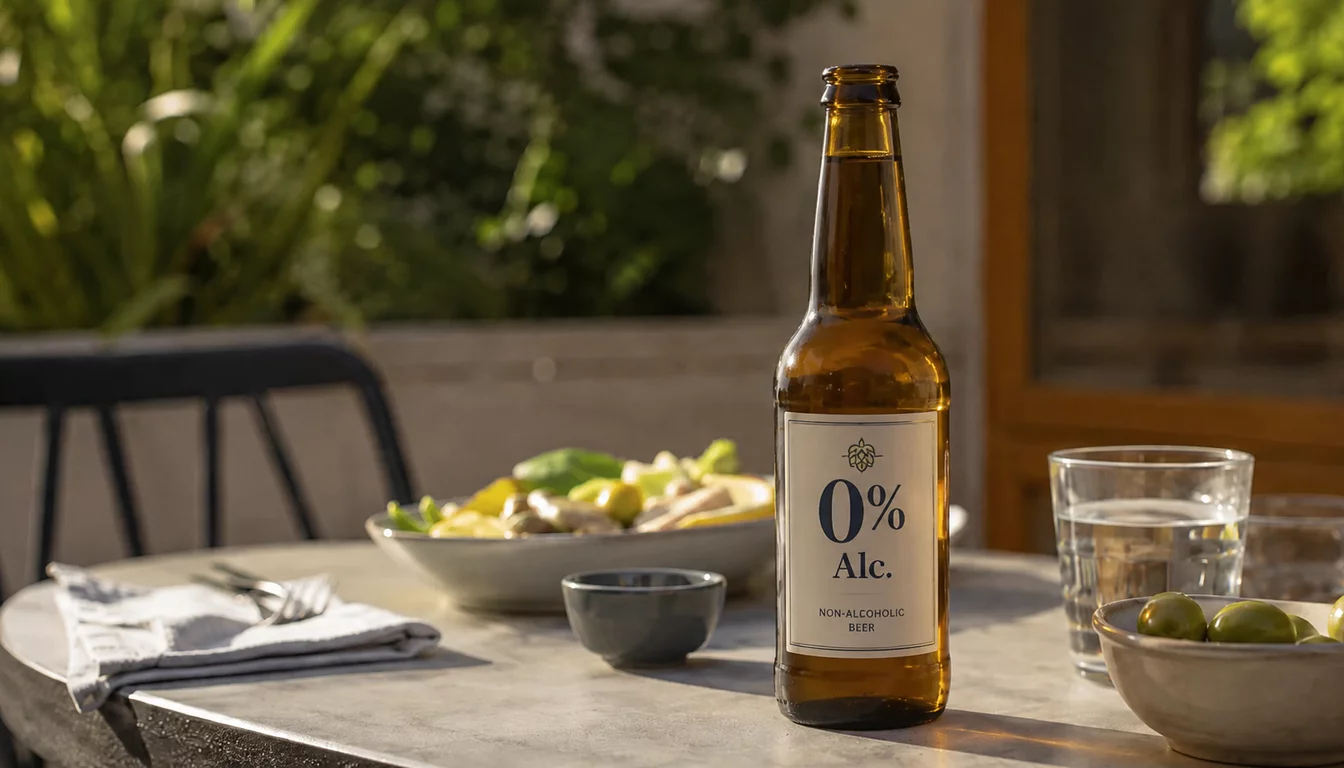
Is Non-Alcoholic Beer OK in Recovery? An Honest Answer
Written by Jakub Havelka
Software engineer · 10+ years in recovery · Author of the Craving Toolkit
You're standing in front of the fridge at a friend's barbecue, and someone hands you a cold can. The label says "non-alcoholic." It looks like a beer, sweats like a beer, and the cap hisses like a beer. Your hand closes around it before your recovery brain catches up.
The question lands a second later: is this okay?
Short answer: there is no universal answer. For some people in long-term recovery, non-alcoholic beer is a useful tool. For most people in early recovery from alcohol use disorder, it's a trap dressed up as a solution. The risk is rarely the trace ethanol. The risk is the cue.
Is there actually alcohol in non-alcoholic beer?
Yes — a little. In the US, beverages labeled "non-alcoholic" can contain up to 0.5% alcohol by volume — a small fraction of a regular beer, which typically runs around 5% ABV. Pharmacologically, this amount does not get a healthy adult intoxicated, and most addiction physicians don't treat it as a meaningful dose of ethanol.
Lembke describes a patient named Joan, a long-term AA member who accidentally drank a low-alcohol beverage while traveling in Italy — an amount Lembke compares directly to American non-alcoholic beers. Joan's sponsor told her to reset her sobriety date. Lembke initially found this rigid, but later came to see the logic: it guarded against the slippery slope and reinforced Joan's bond to the group. The biological dose was negligible. The symbolic dose was not.
That distinction is the whole conversation.
The chemical risk of NA beer is small. The cue risk is not.
Why does non-alcoholic beer trigger cravings?
Your brain didn't get addicted to ethanol in a vacuum. It got addicted to a specific ritual — the smell of hops, the carbonation on the back of your throat, the curve of the bottle in your hand, the time of day, the chair you sat in, the way your shoulders dropped after the first sip. Duhigg's habit-loop framework — cue, routine, reward — predicts almost exactly what happens when you reintroduce most of those elements without the active drug.
The cue fires. The craving surges. The reward delivery fails.
This is often worse than not drinking at all, because the loop gets activated without resolution. You spend the rest of the evening with a low-grade pull you didn't have before you opened the can. Duhigg's other key insight, drawn from research on AA, is that successful recovery replaces the routine while keeping the cue and delivering a similar reward through a different channel — talking to a sponsor, attending a meeting, holding a different drink. Non-alcoholic beer does almost the opposite. It keeps the cue, mimics the routine, and delivers a hollow version of the reward. That's habit-loop reinforcement disguised as harm reduction.
Some people can absorb that and stay sober. Many can't.
If you've been sober for a while and still get vivid drinking dreams, you already have evidence that the old cues are still alive in your nervous system. NA beer feeds those cues directly.
Who is most at risk from non-alcoholic beer?
A few patterns make NA beer especially dangerous, and you probably know which ones describe you.
Early recovery. In the early months of recovery, cue-reactivity is at its sharpest. Your nervous system is still wired for the old loop. This is not the time to test it.
Identity-level drinking. If beer was part of who you were — the IPA guy, the craft beer enthusiast, the person who knew every brewery in town — then drinking a non-alcoholic version is not a neutral act. It's a re-entry into the identity you spent months trying to leave behind.
Solitary drinking patterns. If you used to drink alone, opening an NA beer alone reproduces almost the entire emotional script. The risk of stepping up to the real thing is highest when no one is watching.
Active cravings or recent slips. If you're already wobbly, adding a cue-rich beverage to the equation is a bad bet. There is no upside that outweighs the downside.
On naltrexone or disulfiram. Lembke writes about naltrexone as a form of pharmacological self-binding — it blocks the opioid receptors that mediate alcohol's reinforcement, and many of her patients report a near-total cessation of alcohol craving on it. The medication is not designed to defend you against the psychological cue of a beer-shaped object in your hand. If you're using naltrexone as part of your plan, don't ask it to do work it wasn't built for.
The trace ethanol won't undo your recovery. The ritual might.
When can non-alcoholic beer actually help?
There are real cases where NA beer is a useful tool, and pretending otherwise isn't honest.
If you have years of stable sobriety, a strong recovery community, no recent cravings, and you find yourself at a wedding or a work dinner where holding something that looks like a beer makes the evening easier — many clinicians won't object. Some people in long-term recovery use NA beer specifically to navigate social situations without the "what are you drinking?" interrogation. If social anxiety without alcohol is your main struggle, an NA option may be the lesser of two costs.
If you're approaching the question through a harm-reduction or controlled-use lens rather than full abstinence — a legitimate path for some people, discussed in moderation vs abstinence — the calculus shifts again. But be honest about which path you're actually on. NA beer used as a stepping stone toward moderation is a different decision than NA beer used as a sneak-up to old drinking.
The honest test is simple. Try it once, in a low-stakes setting. Pay attention to what happens in the hour after. Do you feel settled, or do you feel a pull toward the real thing? Did the cue fire and resolve, or fire and escalate?
If your answer is "I want another, and I want it stronger," you have your answer.
What should you do instead?
If you're not sure, default to abstaining from anything beer-adjacent for the first year. The cost is low. The downside protection is high.
Build a non-beer drink that you actually like — a real one, not a sad glass of warm club soda. Sparkling water with bitters and citrus. Cold-pressed juice with lime and salt. A complicated mocktail that takes effort to make. The point is to give your hands and your ritual something to do, without reactivating the loop you spent months breaking.
If you're months in and still feel flat — which is normal during the dopamine deficit state of early recovery — NA beer will not fix that. The flatness is your reward system recalibrating. Drinking something that mimics your old reward signal slows that recalibration down.
Tell one person in your recovery network — sponsor, therapist, friend — before you try NA beer for the first time. Not for permission. For accountability. Anything you have to hide is something you shouldn't be doing.
And if you're in early recovery and the urge to drink — alcoholic or not — feels overwhelming, the SAMHSA National Helpline is free and confidential at 1-800-662-4357. They route to local treatment and peer support 24 hours a day, 365 days a year.
You are allowed to make the careful choice.
Sources
- Lembke A. Dopamine Nation: Finding Balance in the Age of Indulgence. Dutton, 2021. - Duhigg C. The Power of Habit: Why We Do What We Do in Life and Business. Random House, 2012. - US Food and Drug Administration. Labeling guidance for beverages marketed as "non-alcoholic" (≤0.5% ABV). - SAMHSA National Helpline: 1-800-662-HELP (4357). Substance Abuse and Mental Health Services Administration.
The Craving Toolkit includes a Trigger Map worksheet and an Emergency Card designed to help you make these decisions before you're standing in front of the fridge — not after.
Frequently Asked Questions
- Does drinking non-alcoholic beer count as breaking sobriety?
- There is no medical consensus. Pharmacologically, the 0.5% ABV in most NA beers is not an intoxicating dose. Most twelve-step communities, however, treat any deliberate alcohol consumption as a relapse. Lembke describes a patient whose sponsor required a reset after she accidentally drank a low-alcohol beverage abroad. The dose was negligible; the symbolic weight was not.
- Can non-alcoholic beer actually cause a relapse?
- It can, especially in early recovery. The risk is rarely the trace ethanol — it's the cue. Hop smell, carbonation, bottle shape, and time-of-day signals all reactivate the habit loop that drove your drinking. The craving fires without resolution, leaving you primed for the real thing. The closer NA beer is to your former ritual, the higher the risk.
- How much alcohol is actually in non-alcoholic beer?
- In the US, beverages labeled non-alcoholic can contain up to 0.5% alcohol by volume — a small fraction of a regular beer, which typically runs around 5% ABV. Pharmacologically, this won't intoxicate a healthy adult. Some craft NA brands push closer to the limit; others are essentially zero. Check the label before you assume.
- Is non-alcoholic beer safe if I am taking naltrexone?
- Naltrexone blocks the opioid receptors that mediate alcohol's reinforcement, and Lembke describes patients reporting near-total cessation of alcohol craving on it. But naltrexone was not designed to defend you against the psychological cue of a beer-shaped object in your hand. Talk to your prescriber before testing it, and never use NA beer to circumvent abstinence goals.
- What are better alternatives to non-alcoholic beer in recovery?
- Build a non-beer ritual that you actually like. Sparkling water with bitters and citrus. A complicated mocktail that takes time to make. Cold-pressed juice with lime and a pinch of salt. The goal is to give your hands and your evening structure something to do without reactivating the habit loop tied to beer specifically.