Airport Bar, Flying Sober: How to Walk Past It
Written by Jakub Havelka
Software engineer · 10+ years in recovery · Author of the Craving Toolkit
Terminal B, 6:47 AM. You are already through security. The shoes are back on. The laptop is back in the bag. And the first thing your eyes lock onto, like a homing signal, is the bar across from gate 14. Three people are sitting there with bloody marys. Two more have beers. The bartender is pouring something amber into a rocks glass for a guy in a suit who looks exactly as tired as you feel.
It is not even seven in the morning, and the airport is telling you it is fine.
This is the moment. Not the flight. Not the destination. The walk past the bar.
If you have been sober for any meaningful length of time, you already know that airports are not neutral ground. They are some of the most engineered drinking environments on earth, second only to casinos. Alcohol is sold at every gate, at every hour, with social permission baked into the architecture. Nobody raises an eyebrow at a 6 AM beer in Terminal B. The same beer in your kitchen would feel insane.
You did not become a worse person at the security checkpoint. The environment changed.
Why the airport bar is uniquely dangerous
The terminal stacks triggers like nothing else in civilian life. Stress from screening lines, time pressure, sleep deprivation, the low-grade dread of flying itself. Add to that the cue-routine-reward loop you have been running for years: travel means drink. Vacation means drink. Layover means drink. Business trip means drink.
Charles Duhigg's work on habit loops explains why the bar pulls so hard even after months of sobriety. The cue (airport) was paired with the reward (relief, celebration, social ease, anesthesia) thousands of times. The neural pathway is carved deep. Removing the alcohol does not remove the cue. The cue still fires. The craving still surges. And the airport delivers cues with industrial efficiency: the smell of beer, the sound of ice in a shaker, the visual of glassware lined up behind the bar.
Anna Lembke writes in Dopamine Nation about a patient named Chris who relapsed in a hotel room after months of sobriety, triggered by the simple act of turning on the TV. The cue was that small. An airport delivers a hundred such cues in the time it takes to find your gate.
You are not weak. You are walking through a minefield wearing flip-flops.
Build the plan before you leave the house
The single most important rule of flying sober: every decision is made at home, with a clear head, before the airport gets a vote.
This is the same principle behind a Ulysses contract. Your clear-headed self, sitting on the couch the night before, makes the binding decisions for your triggered self, standing in front of the bar at 6:47 AM. By the time you are in the terminal, the decisions are already made. You are executing, not deciding.
Here is the plan you write before you go:
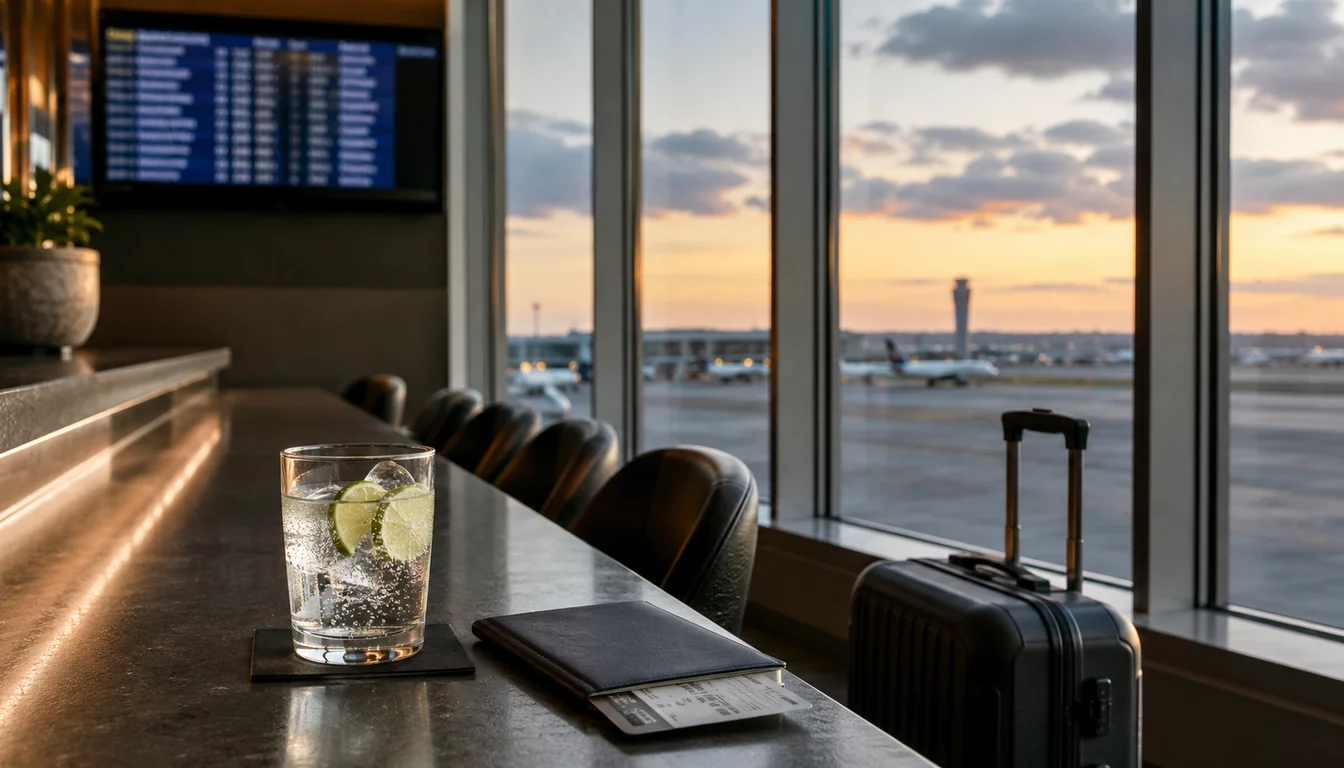
A drink in hand within five minutes of clearing security. Walk straight to a coffee shop or a Hudson News. Buy a large sparkling water, a coffee, or a tea. Hold it. Your hand needs a thing in it. The bar is hardest to walk past when your hand is empty.
A seat picked in advance. Look up your gate before you leave home. Identify a quiet area away from gate bars. Sit there. Stay there. Do not wander the terminal "to kill time." Wandering puts you in front of every bar between gates 1 and 47.
Headphones loaded the night before. A long podcast, an audiobook, a playlist, a downloaded movie. Something that fully occupies your attention. Boredom is the airport's accomplice. Do not give it room.
One person on standby. Text your sponsor, your partner, or a recovery friend before you board: "I'm at the airport. I'll text you when I land." That simple commitment creates accountability and a thread back to your sober life.
A reason for not drinking, rehearsed and ready. If anyone asks, you have a one-sentence answer ready. "I'm not drinking today." That is the whole sentence. You do not owe more.
Decide once. Execute many times.
The 6 AM beer trap
Something about the early-morning airport beer feels like a special permission slip. The lighting is industrial. You have been awake since 4. The flight is delayed. The guy two seats over is on his second pint. The internal voice says: this doesn't count, you're not at home, nobody you know is here.
This is the addictive voice doing its best work. It thrives on liminal spaces. Airports are pure liminal space. You are between cities, between time zones, between identities. The rules feel suspended.
They are not suspended. The drink at 6 AM in Terminal B is the same drink at 6 AM in your kitchen. The fact that other people are doing it does not change what it does to you. The bartender does not know your sobriety date. The flight attendant does not know about the three rehabs. The airport is not your friend.
When the voice says "who would even know," the answer is: you would. And the relapse loop is the same loop it has always been.
Flying without alcohol once you board
Walking past the bar is one battle. The plane is another.
Beverage service is going to come around. Someone in the row in front of you is going to order wine. You are going to smell it. The flight attendant is going to ask what you want with the casual tone of someone offering you a mint.
Have your answer ready before they reach your row. Tomato juice and water. Ginger ale. Coffee. Decide on the jet bridge, not in the moment.
Flight anxiety is the second trap. If you used to drink to manage fear of flying, the absence of alcohol can crank the anxiety up to levels you have not felt in years. Plan for this. Download a calming app before you board. Bring a book that absorbs you. Use the breathing exercises that work for you on the ground. Many newly sober people discover that flight anxiety, once it is no longer being self-medicated, is more manageable than they remembered, just unfamiliar.
If your anxiety is severe enough that you genuinely cannot fly without help, talk to your doctor before the trip. There are non-addictive options. Do not improvise this in the air.
What if you are flying to a vacation
This is its own category of difficulty. The destination matters as much as the journey. If you are heading to your first sober vacation, the airport is the opening move in a multi-day operation.
Pack the same way you would pack for any high-risk environment: with structure. Know the meetings at your destination. Know the address of one place you can sit alone and reset. Have a check-in scheduled with someone back home. The vacation does not start when you land. It starts when you commit to staying sober through it, and the airport bar is the first test of that commitment.
You can have a good trip without a single drink. The version of you that thinks otherwise is the version that needs the most supervision.
When the craving hits anyway
Sometimes you do everything right and the urge still lands like a freight train. You walk past the bar, you have your water, you sit by your gate, and the craving floods in anyway.
This is normal. This is not a failure of the plan. This is the cue doing what cues do.
What works in the terminal: get up and walk. Not toward another bar, but in a loop around your section of the terminal. Physical movement breaks the urge. Call someone. Text someone. Open a recovery app and read. Use urge surfing and let the wave pass without acting on it. Cravings peak and recede. They are not commands.
If the urge is severe and you genuinely feel you might drink, call the SAMHSA National Helpline at 1-800-662-4357. It is free, confidential, and available 24/7. You can call from a bathroom stall. You can call from a quiet corner of the gate. Nobody around you will know.
The bar is not your only option, even when it feels like it is.
You do not have to drink to be a traveler
Years of drinking taught your brain that travel and alcohol belong together. They do not. Millions of people fly every day without ordering at the gate bar. Pilots fly under strict federal limits. Flight attendants do too. The crew operating your aircraft is bound by federal regulation to abstain from alcohol for hours before duty and to stay well under a strict blood-alcohol threshold while on the job, and they manage just fine.
You are not less of an adult because you walked past Terminal B with a sparkling water. You are an adult who knows what would happen if you did not.
The walk past the bar gets easier. Not the first time. Not the tenth time. But after enough trips where you arrive at your destination still sober, still proud, still capable of being present for whatever the trip was actually for, the bar starts to look like what it is: a room full of strangers paying $14 for something that used to ruin your life.
You are not missing anything. You are bringing yourself home.
Sources
- Duhigg C. The Power of Habit: Why We Do What We Do in Life and Business. Random House, 2012. - Lembke A. Dopamine Nation: Finding Balance in the Age of Indulgence. Dutton, 2021. - SAMHSA National Helpline. 1-800-662-4357. Substance Abuse and Mental Health Services Administration. - 14 CFR 121.458 and 49 CFR Part 121. Federal regulations on crew member alcohol use and pre-duty abstinence requirements.
The Craving Toolkit includes a printable travel-day plan and emergency card you can keep in your boarding-pass sleeve, plus scripts for the moments when the bar starts to look like a friend.
Frequently Asked Questions
- Why are airports such a strong trigger for people in recovery?
- Airports combine stress, boredom, social permission to drink at any hour, and bars at every gate. Travel itself is associated with old drinking rituals: the celebratory beer before takeoff, the wine on the plane. The environment is engineered to make drinking feel both normal and deserved.
- Should I avoid flying during early sobriety?
- If you can postpone non-essential travel during the first 90 days, do. The airport is one of the most cue-dense environments you will encounter. If travel is unavoidable, treat it as a high-risk event: tell your sponsor, pack a sober kit, book direct flights, and avoid layovers in unfamiliar terminals.
- How do I manage flight anxiety without alcohol?
- Use what flight crews use: slow nasal breathing, hydration, and movement before boarding. Download a meditation app, a long podcast, or a comfort movie before you leave. If you have severe flight anxiety, talk to your doctor before your trip about non-addictive options. Do not self-medicate with alcohol.
- What should I order at an airport bar if I'm meeting someone there?
- Order first, before anyone asks. Sparkling water with lime, ginger beer, a coffee, or a non-alcoholic beer if you trust your relationship with it. Holding a glass solves the hands problem. If you are newly sober, skip non-alcoholic beer entirely. The taste cue alone can light up the craving loop.
- What if I'm traveling with people who want to drink at the gate?
- Tell them before you arrive at the airport, not after. Pre-commit out loud: 'I'm not drinking today.' If they pressure you, walk to a different gate area and meet them at boarding. You do not owe anyone an explanation while standing next to a tap handle.
- Where can I get help if I'm about to relapse at the airport?
- Call the SAMHSA National Helpline at 1-800-662-4357. It is free, confidential, and available 24/7. You can also open a recovery app, call your sponsor, or find an AA meeting at your destination before you land. Many major airports have chapels with quiet rooms.