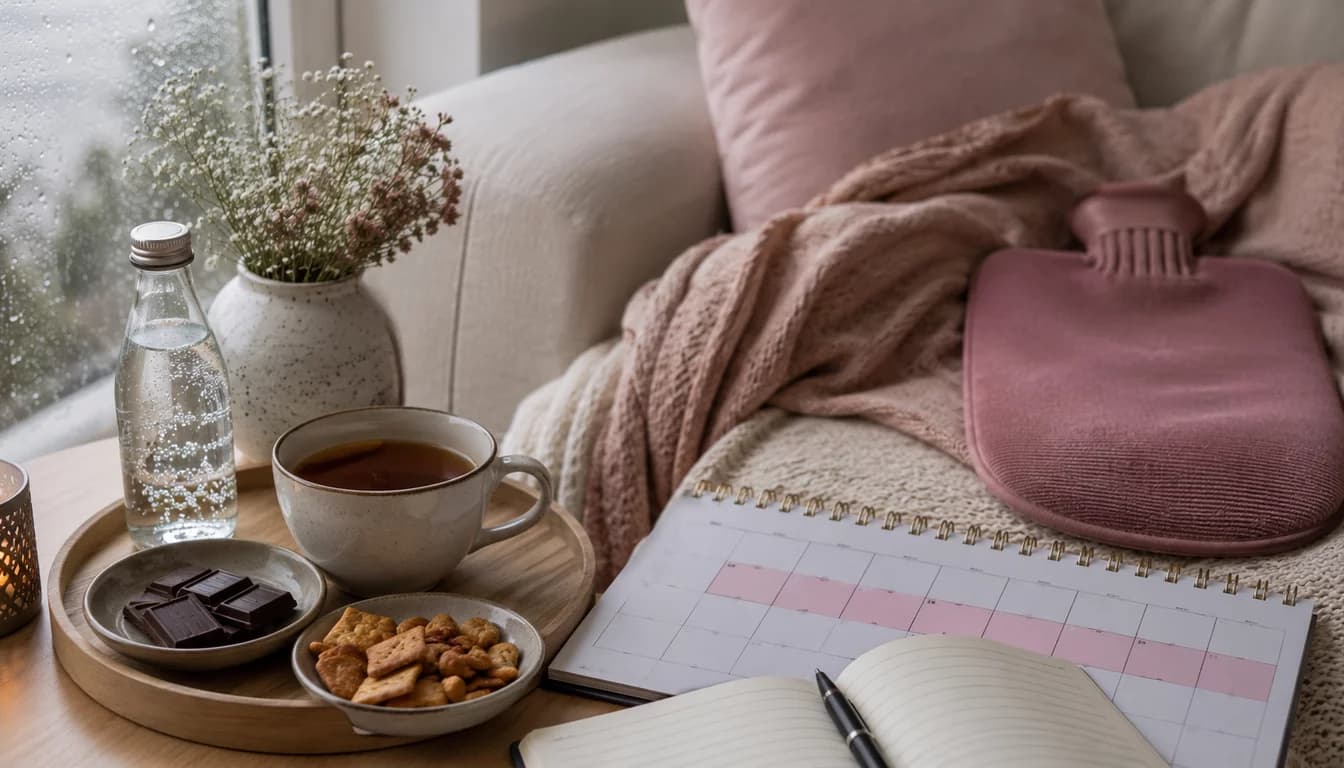
Cravings During PMS Week: Why It Hits Harder, What Helps
Written by Jakub Havelka
Software engineer · 10+ years in recovery · Author of the Craving Toolkit
The craving feels different this week. Sharper. Louder. More urgent. You went five days last week without thinking much about it, and now suddenly the old script is back at full volume, and you can't tell if you're losing your recovery or losing your mind.
You're probably losing neither. You're in the luteal phase.
The week before your period reshapes the chemistry that recovery depends on. Hormones shift, blood sugar destabilizes, sleep gets choppier, and the brain's reward system gets louder. If you're in recovery from a substance, a behavior, or a binge pattern, this is the week most likely to take you down, and almost nobody warns you about it specifically.
Why does the PMS week intensify cravings?
Estrogen falls. Progesterone rises and then falls with it. Serotonin drops. The Cleveland Clinic describes the luteal phase as a combination of hormonal shifts, blood-sugar instability, and reduced serotonin activity. Healthline puts the craving window at roughly five to ten days before menstruation, and most women feel it before they can name it.
UCLA Health has reported on research showing the brain becomes less sensitive to insulin during the luteal phase. Translation: your brain reads itself as undernourished even when it isn't, and demands the foods that fix that quickly: sugar, refined carbs, salt, and chocolate.
That mechanism explains food cravings. It also explains why women in recovery from alcohol, nicotine, stimulants, or compulsive behaviors often see a spike in those urges during the same window. The reward system doesn't have separate channels for chocolate and bourbon. It has one channel, and the luteal phase turns up the volume on whatever is wired into it.
This is not weakness. This is biology. And the first step is to stop interpreting the spike as a moral failure.
When do PMS cravings typically start and stop?
The standard pattern: cravings begin five to ten days before bleeding starts, peak in the final couple of days before, and usually resolve within the first day or two of your period. Cleveland Clinic, Healthline, and most clinical sources converge on this window.
It varies. Some people feel the shift earlier in the cycle. Some feel it only in the final 48 hours. If you've never tracked it, start now. Even a simple note on your phone for two or three cycles will reveal a pattern you can plan around.
The point is not the exact timing. The point is that the cravings are predictable.
Predictable means plannable.
How do I plan for the PMS week in recovery?
The mistake is to treat the PMS week the same as any other week, then act shocked when it goes badly. The fix is to plan for it as a known high-risk window, the same way you would plan for travel, a holiday, or a stressful work week.
Move support earlier in the cycle. Schedule your therapy session, your meeting, your check-in call, or your hardest conversation for the days before the storm. Your calm self should make decisions for your triggered self. When you know the storm is coming on day 23, day 20 is when you set the guardrails.
Eat before the craving fires. UPMC HealthBeat and Cleveland Clinic both emphasize the role of stable blood sugar. Protein at breakfast. Complex carbs instead of refined ones. Snacks that include fat and fiber. This isn't a diet. It's reducing the size of the wave before it breaks. If you're in early sobriety, appetite is already shifting on its own, and the luteal week will compound that.
Front-load sleep. Sleep gets worse in the luteal phase even when nothing else changes. Going to bed earlier in the week before your period is a small intervention that pays out as more emotional stability and less impulsivity. Tired brains lose to cravings.
Lower the bar for everything else. The PMS week is not the week to start a new exercise program, take on extra commitments, or have a hard conversation with a parent. Protect the perimeter.
Conserve energy for the one thing that matters: not feeding the craving.
What do I do when the craving hits anyway?
You've planned, and the craving still arrived at 7 PM on a Tuesday with the force of a freight train. This is normal. Planning shrinks the wave; it does not cancel it. If your cravings already concentrate after dark, the luteal phase amplifies what the evenings already do.
Eat something with actual substance. Not because hunger caused the craving, but because the brain reads low blood sugar as an emergency. Peanut butter on toast, a hard-boiled egg, or a bowl of oatmeal can move a craving from a 9 to a 6 within fifteen minutes. This is a luteal-phase intervention, not a long-term coping strategy. Use it.
Use the wave. Cravings rise, peak, and fall. The luteal-phase craving is louder, but it follows the same arc. The discipline is to wait it out without acting. Urge surfing is the structured version of this: watching the sensation without merging with it.
Move the body. Twenty squats, a brisk walk around the block, cold water on your face. The physical interruption breaks the loop the craving is trying to complete.
Name what's actually happening. Say it out loud if you have to. "This is the PMS spike. It will peak and pass. I am not broken; I am ovulating-minus-eight." Naming the source of the signal weakens the signal.
Does the PMS week make alcohol and drug cravings worse?
Yes, and the women who relapse during it often report afterward that they didn't see it coming. The cycle wasn't on their radar as a risk factor. Their sponsor didn't ask. Their treatment program didn't address it.
There is a parallel pattern in perimenopause alcohol cravings. The same hormonal mechanisms that make the luteal week harder also intensify substance cravings in the years leading up to menopause. If you're tracking one, track both.
If your cravings are for substances and they spike around your cycle, treat the pattern as clinically relevant information. Tell your therapist. Tell your doctor. If you're in early recovery and you're noticing the pattern for the first time, you are not relapsing. You are encountering a known difficulty that recovery literature has historically underdiscussed.
If you are at risk of returning to a substance and need help right now in the US, SAMHSA's national helpline is 1-800-662-4357. It is free, confidential, and open 24/7.
Is it okay to give in to food cravings during PMS?
For food, the answer from most clinicians is yes, within reason, and with intention. Cleveland Clinic and Healthline both recommend satisfying cravings with better-quality versions of the craved food rather than white-knuckling restriction that usually ends in a binge.
For substances and compulsive behaviors, the answer is no, but that does not mean willpower. It means structure. A planned-for high-risk week, a written script for the worst moments, and the recognition that the chemistry will normalize within days.
The PMS week is a wave you can plan for, not a verdict on your recovery.
Sources
- Period Cravings: Explanation and How to Deal. Healthline. - Cause of Period Cravings and How To Manage Them. Cleveland Clinic. - Menstrual cravings ARE all in your head, in your brain. UCLA Health. - 5 Tips for Coping with PMS Cravings. UPMC HealthBeat. - Duhigg C. The Power of Habit: Why We Do What We Do in Life and Business. Random House, 2012.
The Craving Toolkit includes a Cycle-Aware Trigger Map worksheet for tracking how your cravings shift across the month, so your calm self can pre-load decisions for the luteal week.
Frequently Asked Questions
- When do PMS cravings typically start and stop?
- Most clinical sources, including Cleveland Clinic and Healthline, describe cravings starting roughly five to ten days before menstruation and resolving within a day or two of bleeding. The exact window varies by person. Tracking two or three cycles on your phone will reveal your personal pattern so you can plan for it instead of being ambushed.
- Why do I crave sugar and carbs during the week before my period?
- Estrogen and serotonin both drop during the luteal phase, and UCLA Health reports the brain becomes less sensitive to insulin in this window. The brain reads itself as undernourished and demands quick-fix foods. Carbs trigger a serotonin bump that temporarily restores mood, which is why the craving feels so specific and so urgent.
- Can hormonal changes make alcohol or drug cravings worse?
- Yes. The reward system that drives alcohol and drug cravings is the same system the luteal phase amplifies. Many women in recovery report a predictable spike in substance urges during PMS week. Track the pattern, tell your therapist or sponsor, and treat the week as a known high-risk window for relapse, not a personal failure.
- How can I reduce cravings during PMS week?
- Plan the week before it arrives. Eat protein and complex carbs to stabilize blood sugar. Front-load sleep on the days you usually feel worst. Move difficult conversations and new commitments out of the window. When the craving hits anyway, eat something substantial, move your body, and name the spike out loud as luteal-phase chemistry.
- Is it okay to give in to PMS cravings?
- For food cravings, satisfying them with better-quality versions of what you actually want usually works better than restriction, which often ends in a binge. Cleveland Clinic and Healthline both recommend this approach. For substances and compulsive behaviors, no, but the answer is structure and planning, not willpower against a wave of hormones.