First Sober Birthday: How to Survive the Day
Written by Jakub Havelka
Software engineer · 10+ years in recovery · Author of the Craving Toolkit
The cake is in the fridge. Someone has already texted "what are you doing for your birthday???" with three question marks. Your phone keeps lighting up with old friends — the ones who only show up when there's a reason to drink — and you can feel the day approaching like weather.
This is the first birthday since you stopped. And the part of you that used to organize the whole evening around the first toast is awake again, listing reasons why one night wouldn't matter.
It would matter.
The first sober birthday is one of the highest-risk single days in early recovery, and almost nobody warns you about it. People worry about Christmas and New Year's. They forget that your birthday is a personal holiday with your name on it, and that your brain has rehearsed celebrating it the same way for ten, twenty, maybe thirty years.
Why does the first sober birthday feel like a setup?
Because it is one — structurally, not maliciously.
A birthday combines three of the strongest relapse triggers in one window. There's a cue (the date itself, the songs, the gathering). There's social permission ("come on, it's your birthday"). And there's nostalgia, which is the most underestimated trigger of all. Your brain is being asked to remember every previous birthday, and almost all of those memories include the substance.
Gabor Maté, writing in In the Realm of Hungry Ghosts, describes how relapse rarely arrives as a sudden decision. It arrives as a slow assembly of permissions. His patient Sean told him, "I thought I'd just use one time, just the one time. And that was it." A birthday is the kind of day that hands you that exact sentence on a paper plate.
The day is also emotionally loud. You're being celebrated, which feels good, but you're also being observed, which doesn't. People keep asking how you're doing. The contrast between the version of you who used to host these nights and the version of you trying to sit through one is sharper than usual. The addictive voice gets unusually articulate on days like this.
You are not weak for feeling shaky. You are paying attention.
How do I plan a sober birthday that doesn't trigger me?
The single biggest predictor of how the day goes is whether you decided how it would go before it started.
Don't wing it. The default plan — whatever your old social circle expects — was designed by your addicted self. It will deliver you to a room full of drinks within four hours.
Pick the shape of the day in advance. Where are you in the morning? Who are you with at dinner? When does the day end? Write this down. The Craving Toolkit calls this preparing your triggered self with your calm self, and birthdays are one of the clearest cases where the two selves are genuinely different people.
Choose one anchor activity that isn't drink-shaped. Hiking, a movie, a long lunch somewhere that doesn't serve alcohol, a massage, a museum, a road trip to see one specific person. The anchor needs to take up enough hours that the evening becomes a follow-on, not a centerpiece. People in early recovery often try to white-knuckle through a traditional drinking party. It almost never works the first year.
Invite fewer people, not more. Volume of attendees correlates directly with volume of drinks offered. A small group of three or four — at least one of whom knows you're sober and is on your side — is a vastly safer container than twenty acquaintances who will keep cycling through the bar.
Decide where you sleep. This sounds odd until you've had a 1 a.m. craving in a strange Airbnb after a long day of toasts. Sleep at home if you can, or somewhere familiar and substance-free. Many first-year relapses happen after the party, not during it.
If the whole thing feels like too much engineering for one day, remember: this is the same logic you'd apply to a first sober vacation or a first sober Christmas. High-risk days deserve real plans.
What do I say when someone hands me a drink?
You will be handed one. Probably several. Birthdays in drinking cultures are coordinated around the toast, and people who love you will reach for a glass on your behalf without thinking.
You need a sentence. Memorize it. Say it the same way every time.
Something like: "I'm not drinking this year — sparkling water is great." Short, declarative, no apology. The "this year" softens it for people who can't handle "ever," and it gives you cover without committing you to a story you don't want to tell.
If someone pushes — and someone always does — repeat the same sentence. Don't escalate. Don't argue. Don't explain the neuroscience. The broken-record technique works because the pushing usually comes from someone who is themselves uncomfortable with your sobriety, and a calm repetition signals that the conversation is over.
For the host or your closest friend, brief them privately before the event. Ask them to deflect on your behalf. A second voice saying "she's not drinking, leave it" carries weight that your voice alone can't.
The goal isn't to convince anyone. The goal is to not be drinking at the end of the night.
What if cravings hit in the middle of the celebration?
They might. Plan for it now, when your head is clear.
Charles Duhigg's work on habit loops describes how deeply context shapes a habit: the same cues that fire reliably inside a familiar setting can lose their grip when the surrounding context changes. A birthday is the opposite of a context change. The cake, the song, the specific friend who used to drink with you — these recreate the full context your old loop was built in. You can't preempt every cue. You can change the context around them, and you can preempt your response.
Step out of the room. Always step out. Bathrooms, balconies, parking lots, the street outside — any space with a door between you and the trigger. Cravings shrink fast when the cue stops being directly visible.
Text someone. Not a casual text. A pre-agreed code with one person who knows it means "I am struggling right now and need you to text me back within five minutes." Sponsor, sober friend, partner, anyone. If you don't have someone like that yet, the SAMHSA National Helpline at 1-800-662-4357 is free, confidential, and answers twenty-four hours a day.
Wait fifteen minutes before deciding anything. Cravings rise and fall in waves; the decision you would make at minute three is almost never the decision you'd make at minute twenty. This is the same delay logic that works in any acute urge — the urge wants speed, and time alone defeats it.
If you need to leave the party entirely, leave. You don't owe anyone an explanation tonight. Send a thank-you message tomorrow.
Leaving is not a failure. Drinking would be.
How do I make the day actually mean something?
Birthdays in active addiction are usually about anesthetizing the day, not honoring it. Sober birthdays give you the chance to do something the drinking version couldn't: actually be there.
Spend part of the day with someone who knew you at your worst and still showed up. Write down where you were on this date one year ago, and where you are now. Eat a meal you remember. Take a long walk. Call someone you've owed a call to.
Andrew Huberman's conversation with addiction specialist Brad Soave makes a point worth holding onto: people in recovery slowly rebuild a tolerance for stress, not just a tolerance for staying sober. Each high-pressure day you survive intact adds a layer to that tolerance. Your first sober birthday isn't a hurdle — it's training. Next year's will be easier because of how you handle this one.
And building the social side of recovery, one event at a time, is part of making sober friends as an adult. The birthday is one node in a longer project.
You don't need the day to be beautiful. You need it to end with you still sober. That's the whole assignment.
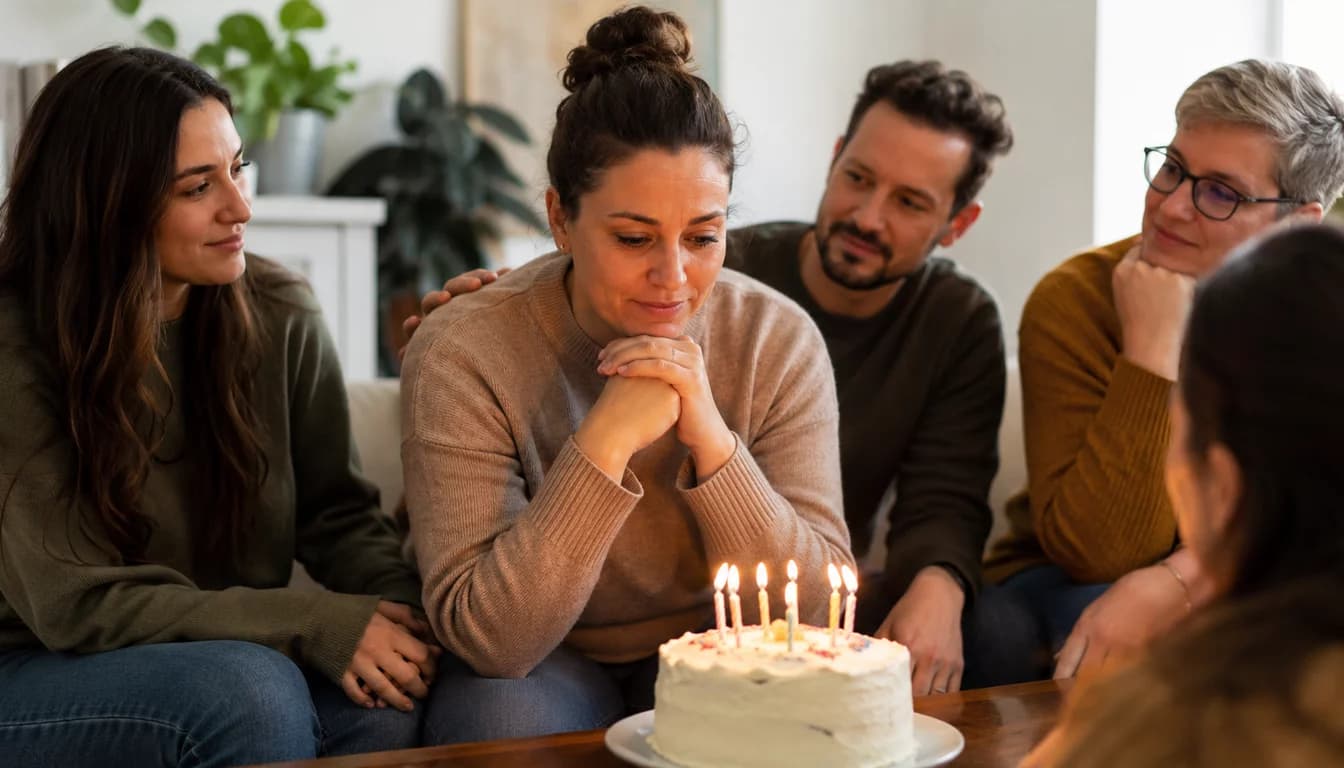
The cake can be anything. The candles still light. You're the one blowing them out this year, and you'll remember it.
Sources
- Maté G. In the Realm of Hungry Ghosts: Close Encounters with Addiction. North Atlantic Books, 2010. - Duhigg C. The Power of Habit: Why We Do What We Do in Life and Business. Random House, 2012. - Huberman A, Soave B. Huberman Lab Podcast: Conversation on Addiction Recovery. 2024. - SAMHSA National Helpline. 1-800-662-4357. U.S. Department of Health and Human Services.
The Craving Toolkit includes a printable High-Risk Day worksheet — designed for birthdays, anniversaries, and other dates your addicted self has rehearsed for years.
Frequently Asked Questions
- Why does the first sober birthday feel more dangerous than other days?
- Because birthdays carry a culturally sanctioned permission slip to drink. Every other day in early recovery, you can argue with the addictive voice. On your birthday, the voice gets backed up by friends, family, and tradition. The pressure isn't only internal anymore — it's coming from the room.
- Should I tell people I'm not drinking, or just quietly decline?
- Tell at least one person in advance, ideally the host or your closest friend. Quiet declining works for strangers, but at your own birthday people will keep offering. A short pre-arranged sentence — "I'm not drinking this year, please don't push it" — saves you from explaining ten times while the cake melts.
- What if my whole social circle drinks and I have nowhere sober to go?
- Build a small alternative event before the main one — coffee, a hike, a dinner with one safe person. You still attend the louder party if you want to, but the meaningful part of the day is already banked. If you have no safe person, an AA or SMART meeting on your actual birthday is a reliable anchor.
- Is it okay to skip my birthday entirely the first year?
- Yes. Skipping isn't failure — it's harm reduction. Many people in early recovery treat year one as a logistical year, not a celebratory one. Take the day off work, do something quiet, and save the big party for year two when your nervous system has more bandwidth to enjoy it.
- What do I do if a craving hits in the middle of the celebration?
- Leave the room. Step outside, into the bathroom, into your car — anywhere with a door between you and the trigger. Text your sponsor or a sober friend. Wait fifteen minutes before deciding anything. Cravings peak and fall; the decision you'd make at minute three is rarely the one you'd make at minute twenty.