Restless Legs Quitting Alcohol: Why It Happens, How Long
Written by Jakub Havelka
Software engineer · 10+ years in recovery · Author of the Craving Toolkit
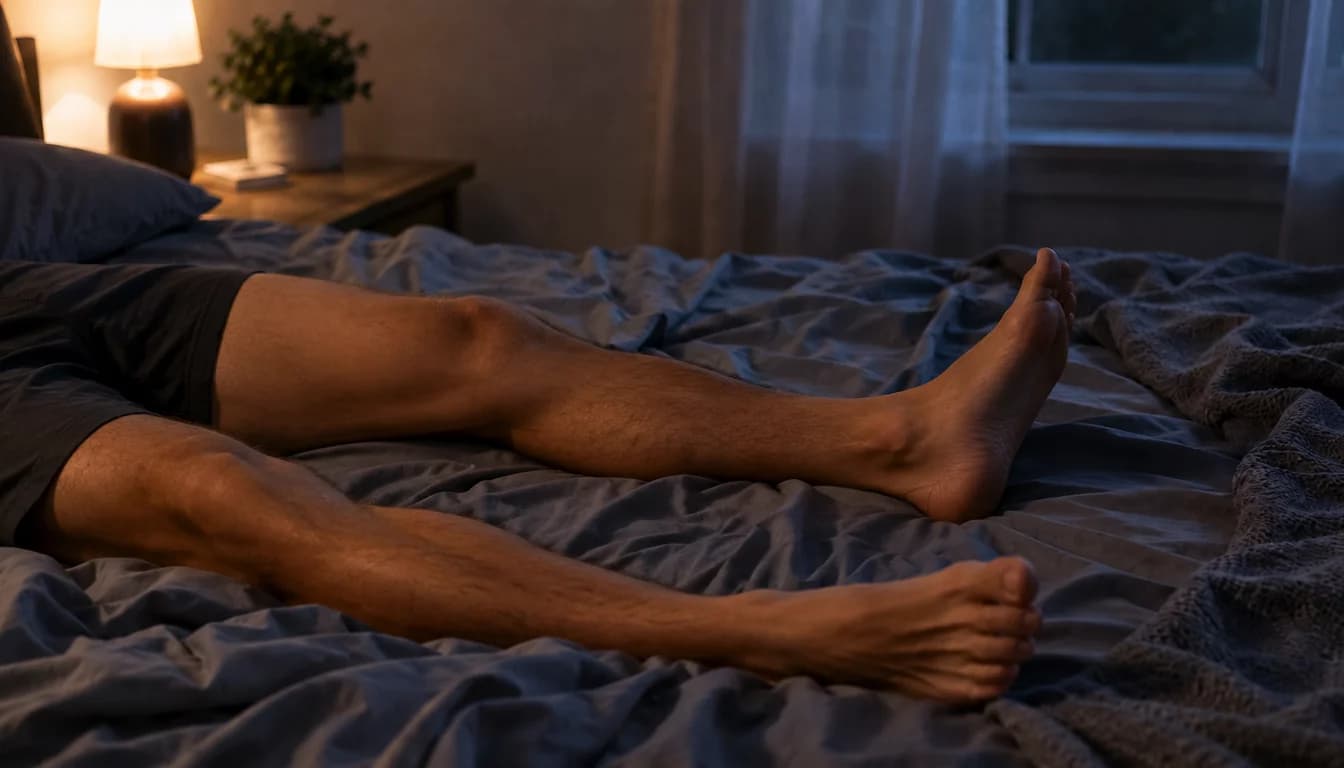
You wake at 2 AM, three days into not drinking, and your legs are doing something you can't control. A crawling sensation that lives somewhere inside the muscle, not on the skin. You stretch. You shake. You get up and walk to the kitchen, and the relief lasts about ninety seconds before it starts again.
This is one of the loudest, most underdiscussed parts of early alcohol recovery. Your legs feel possessed. Sleep becomes a war you keep losing.
It's real, it's temporary, and it has a name.
Why do your legs feel restless when you stop drinking?
Alcohol is a central nervous system depressant. For years, every drink has been doing slow-down work for you. It flattened anxiety. It sedated your muscles. It quieted a baseline level of physical static that you may not have noticed was there.
When you remove the alcohol, the brake comes off. Everything that was being suppressed starts firing at once. Restless legs is one of the most physical signatures of that rebound, sitting alongside other classic withdrawal symptoms like night sweats, tremor, and racing thoughts.
A study indexed on PubMed Central tracking patients in supervised detoxification found that 21.7% of people in alcohol withdrawal met the diagnostic threshold for likely restless legs syndrome. That's roughly one in five, far higher than the general population rate.
There's a second factor underneath the withdrawal: dopamine. Restless legs syndrome is closely tied to dopamine regulation in the brain, and years of heavy drinking blunts that system. When the alcohol stops, the dopamine system has to recalibrate, and that recalibration tends to express itself in your legs at night, when the rest of your body is still.
Your legs are not malfunctioning. They're talking.
How long do restless legs last after quitting alcohol?
For most people, the worst nights fall in the first week. Days 2 through 5 are typically the peak, when the nervous system is most chemically destabilized. By the end of the first week, the sensation often loses its sharpest edge. By the end of the first month, it's usually reduced to occasional flare-ups around bedtime, after long flights, or during stretches of acute stress.
Some people carry it longer than that. Anna Lembke writes in Dopamine Nation that the reward pathway reset varies widely. Some patients need less than four weeks; others need far longer, especially if they've been using more potent substances in larger quantities for longer duration. The same logic applies here. The more years you spent drinking heavily, the more time your nervous system needs to find its baseline again.
If your legs are still wrecking your sleep at the three-month mark, that's not the same problem you had on night three. It deserves a conversation with a doctor, because primary restless legs syndrome (the kind not driven by withdrawal) responds to specific treatments that withdrawal-related RLS does not need.
The acute version usually has an expiration date. The chronic version has a treatment plan.
What helps relieve restless legs during alcohol withdrawal?
The honest answer is that there's no single cure. What works is a stack of small, immediate interventions that take the edge off enough to let sleep happen. Layer them.
Move on purpose. A short walk, gentle squats, or a slow stretching sequence interrupts the sensation. The relief is temporary, but temporary is long enough to fall asleep behind.
Use temperature contrast. A warm bath before bed dilates blood vessels and quiets the nervous system. Some people prefer a cool pack on the calves. Both work better than lying there waiting.
Hydrate and replace electrolytes. Alcohol depletes magnesium, potassium, and sodium. Restoring them won't cure RLS, but a stable body needs functioning electrolytes to settle.
Cut caffeine after noon. Caffeine is a known RLS aggravator, and you don't need the additional sleep cost during a phase when sleep is already fragile.
Don't drink to make it stop. This is the one that catches people. A drink will quiet the legs for about an hour. Then the rebound is worse, the timeline resets, and you've reinforced the loop. The kindling effect describes why repeated detox cycles tend to make each withdrawal harder, not easier.
Talk to a doctor about short-term medication. For severe cases during withdrawal, physicians sometimes prescribe dopamine agonists, gabapentin, or other RLS-targeted drugs. This is a medical conversation, not a self-help one.
The goal in week one isn't elegance. It's getting through the night.
What does this have to do with sleep?
Everything. Restless legs and alcohol withdrawal both attack sleep, and sleep deprivation makes both worse. You can find yourself in a feedback loop where the legs prevent sleep, the lack of sleep raises stress, the stress amplifies the legs, and the legs prevent sleep again.
Breaking that loop is one of the most important moves in early recovery. Sleep isn't a luxury during withdrawal. It's a structural part of how the nervous system stabilizes, how dopamine regulation returns, and how cravings stop running the show.
Even if it means sleeping in two-hour blocks, even if it means napping in the afternoon, even if it means going to bed at 8 PM, prioritize sleep above almost everything else in the first two weeks. Skip the social event. Skip the late-night scroll. The legs will quiet down. The dopamine will recover. The sleep will deepen.
All of it takes time, and time is the part of recovery that no one can short-circuit.
When should you call a doctor?
Alcohol withdrawal can be dangerous and occasionally life-threatening. Restless legs by itself is not a medical emergency, but it can appear alongside symptoms that are. Call a doctor or go to an emergency room if you experience:
- Seizures or convulsions
- Severe confusion or hallucinations
- A racing heart that won't slow down
- Persistent vomiting
- A high fever
- Tremors that interfere with basic function
These can be signs of severe withdrawal, including delirium tremens, which requires immediate medical care. Lembke is explicit about this in Dopamine Nation: for people with severe alcohol dependence, quitting all at once without supervision carries real risk, and medically monitored tapering is necessary.
If you don't have a doctor or you're not sure where to start, SAMHSA's National Helpline is free, confidential, and available 24/7: 1-800-662-4357. They will connect you with local treatment options, including supervised detox if you need it.
You don't have to white-knuckle through heavy alcohol withdrawal alone, and you shouldn't.
Sources
- "Prevalence of restless legs syndrome during detoxification from alcohol and opioids." PubMed Central, PMC5193169. - Lembke A. Dopamine Nation: Finding Balance in the Age of Indulgence. Dutton, 2021. - SAMHSA National Helpline: 1-800-662-4357. Substance Abuse and Mental Health Services Administration.
The Craving Toolkit includes structured worksheets for the first 30 days of alcohol recovery, including a Withdrawal Symptom Tracker, an Emergency Card, and a sleep-rebuild protocol designed for the nights when your body won't let you rest.
Frequently Asked Questions
- Can alcohol cause restless leg syndrome?
- Alcohol probably doesn't directly cause primary restless legs syndrome, but heavy drinking can worsen existing RLS and trigger withdrawal-related restless legs. The mechanism involves dopamine disruption, electrolyte loss, and fragmented sleep. People going through alcohol detox develop RLS symptoms at much higher rates than the general population.
- How long do restless legs last after quitting alcohol?
- For most people, the worst nights cluster in the first week of withdrawal, with peak intensity between days two and five. By the end of the first month, the sensation usually fades to occasional flare-ups. Symptoms lasting beyond three months deserve a medical evaluation, since they may indicate primary RLS rather than withdrawal.
- Why do my legs jump when I stop drinking?
- Alcohol was suppressing your central nervous system. When you remove it, the suppression lifts and your nervous system rebounds toward hyperactivity. Combined with depleted electrolytes and disrupted dopamine signaling, this rebound often shows up as involuntary leg movement, especially at night when the rest of your body is still.
- Will a drink make restless legs stop?
- A drink will quiet the legs for roughly an hour, but the rebound afterward is worse and the withdrawal clock resets. Using alcohol to manage withdrawal symptoms reinforces the dependence loop and can make the next attempt harder. Stretching, warm baths, and medical support are safer routes through the worst nights.
- Do I need a doctor for alcohol withdrawal?
- If you've been drinking heavily for years, yes. Alcohol withdrawal can include seizures and delirium tremens, both of which are medical emergencies. SAMHSA's free helpline (1-800-662-4357) can connect you with supervised detox options in your area. Don't attempt heavy alcohol detox alone if you have any uncertainty.