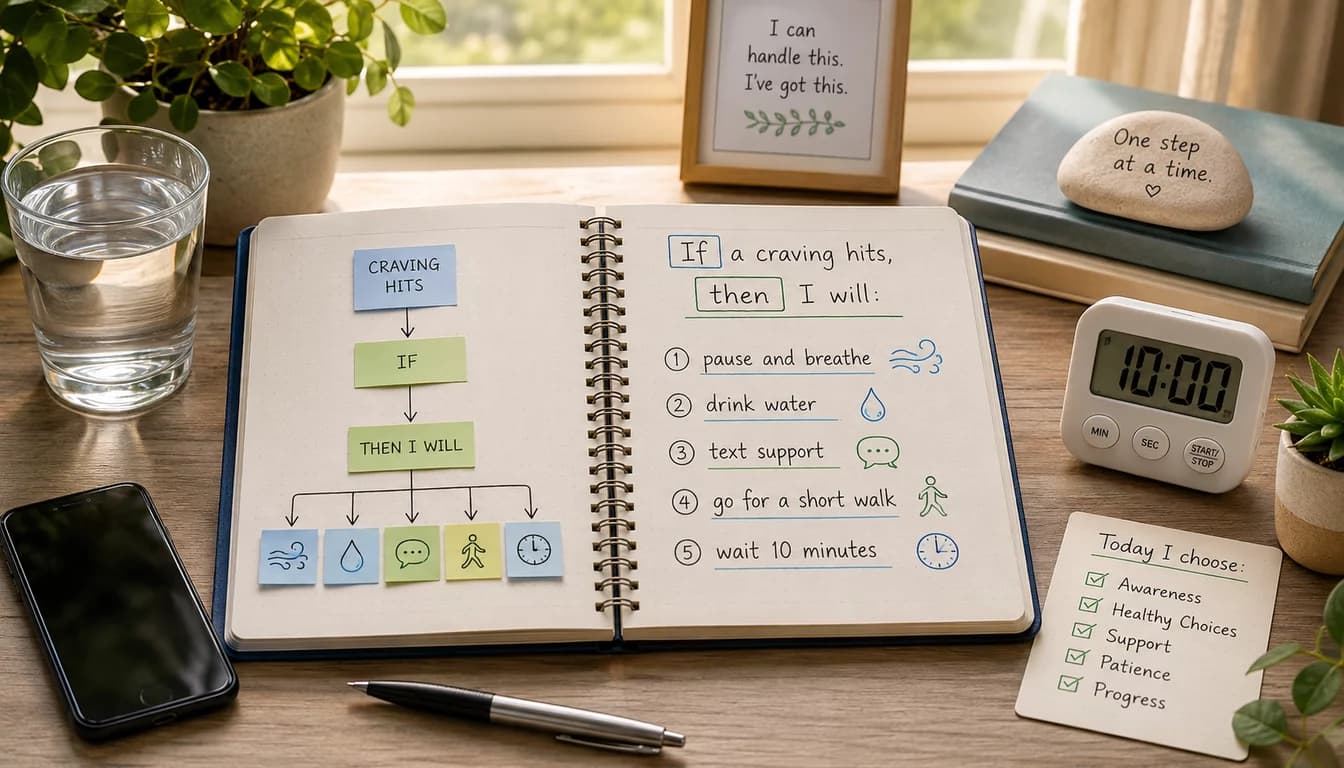
If-Then Implementation Intentions for Cravings
Written by Jakub Havelka
Software engineer · 10+ years in recovery · Author of the Craving Toolkit
It's 6:47 PM. You've been home from work for three minutes. The fridge is six steps away. You haven't decided anything yet, but a chain of micro-actions is already in motion: keys on the counter, jacket off, refrigerator door opening. The first beer is in your hand before any part of you that calls itself "decision-making" has spoken a word.
This is the moment that ruins recovery plans. Not the big philosophical moment about whether you want to be sober. The small, automatic moment when your body is already moving and your mind is just narrating.
The mistake is trying to win this moment with willpower.
You won't. Nobody does. The brain that arrives at 6:47 PM is not the brain that made your sobriety plan at 11 AM on Sunday. It's tired, depleted, and under the chemical influence of a cue it has been trained to respond to for years.
What works instead is a technique psychologists have spent four decades studying: the implementation intention. The if-then plan. A pre-decided response that fires automatically when a specific trigger appears, so the moment of choice happens upstream of the moment of crisis.
What exactly is an if-then implementation intention?
Psychologist Peter Gollwitzer introduced the concept of implementation intentions in the 1990s. The distinction he drew is simple and useful.
A goal intention is a wish: "I want to drink less." "I want to stop scrolling at night." "I want to handle stress without using."
An implementation intention is a plan that specifies exactly when, where, and how you will act: "If I walk through the front door after work, then I will change into running clothes and walk to the park before sitting down." "If I feel the urge to scroll in bed, then I will put my phone in the kitchen drawer." "If my coworker invites me out for drinks, then I will say I have a 7 PM commitment and leave the building."
The structure is rigid on purpose. Situation X → Response Y. No deliberation, no negotiation, no checking how you feel.
Gollwitzer's argument, supported by hundreds of studies summarized in his 2019 chapter with Gabriele Oettingen, is that this format does something a goal intention cannot. It transfers control of behavior from your slow, conscious self to the fast, automatic system that already runs most of your day. The if-then plan piggybacks on the same machinery that addiction uses against you.
If addiction is automation working in the wrong direction, implementation intentions are automation pointed back the right way.
Why does pre-deciding work when willpower fails?
The 2015 review by Wieber, Thürmer, and Gollwitzer in Frontiers in Human Neuroscience laid out what happens in the brain when you form one of these plans. Two things shift.
First, your perceptual system becomes more sensitive to the trigger you specified. You notice the cue faster, sometimes before you're consciously aware of it. The trigger becomes salient in a way it wasn't before.
Second, the link between that trigger and your planned response strengthens so much that the response begins to feel automatic. Brain-imaging studies cited in the review show reduced activation in deliberative regions when people execute behaviors they've if-then-planned, compared to behaviors they're trying to control consciously.
This matters enormously for cravings. As I've written elsewhere about why incentive salience makes you crave what you don't even enjoy, the wanting system runs on autopilot. You can't out-think it in real time because by the time you're thinking, it has already moved you halfway to the behavior. An if-then plan plants a counter-routine in the same automatic layer where the addiction lives.
The review even includes studies with opiate addicts in withdrawal. Even in a state of impaired self-regulation, participants who formed if-then plans completed structured tasks at higher rates than those who only set goals. The plan worked when the brain was at its worst.
That's the point. You don't need an if-then plan when you're calm.
How do you build one for your own cravings?
The cleanest if-then plans share three features: a specific trigger, a specific response, and the words "if" and "then."
Identify your highest-risk cue. Walk through a recent relapse or a near-relapse and find the moment before the moment. Not the drink itself. The moment you walked into the kitchen. The moment your phone buzzed at 10 PM. The moment a specific person texted. This is your "if."
Choose a response that is concrete and physical. "Calm down" is not a response. "Be mindful" is not a response. "Drink a glass of water and walk into the bedroom and close the door" is a response. The body has to know exactly what to do without consulting the mind.
Write it down in the if-then form. Not in your head. On paper, or in a note on your phone you'll actually see. "If I get home from work and feel the pull toward the fridge, then I will change into workout clothes and leave the house for 15 minutes before doing anything else."
Rehearse it mentally. Picture the trigger. Picture yourself executing the response. Do this until the connection feels rehearsed, not theoretical. The studies that show the strongest effects are the ones where participants visualized the if-then chain a few times rather than just writing it.
You can stack plans. One for the after-work window. One for the late-night urge. One for the craving that hits at work when you can't leave your desk. Each one targets a different cue. Together they form a kind of pre-loaded operating system that runs when your conscious self can't.
This is what Charles Duhigg, in The Power of Habit, calls the planning step at the end of habit-loop diagnosis. Once you know the cue and the real reward, you build the if-then plan that delivers the reward through a new routine. The implementation intention is the bridge between knowing what to change and actually changing it.
What does the research say for substances and food?
The 2023 systematic review and meta-analysis by Allom and colleagues, published in Addictive Behaviors, looked at trials of if-then planning for alcohol use across diverse populations. The pooled effect was small but statistically significant: g = 0.31.
That's not a magic bullet. It's a real, replicable nudge in the right direction, comparable to many other behavioral interventions used in recovery.
The Stadler, Oettingen, and Gollwitzer work on mental contrasting with implementation intentions (MCII) shows similar effects for food cravings, exercise adherence, and other self-regulation goals. The pattern is consistent: pre-decided plans outperform good intentions across nearly every domain studied.
What if-then plans don't do is replace the deeper work. They won't repair the reasons you started using. They won't rebuild the parts of life that the addiction hollowed out. They won't fix the bias toward instant gratification that drives so much craving behavior. What they do is buy you the specific moments you keep losing.
That's the value. Recovery is mostly won or lost in specific moments.
What about mental contrasting (MCII)?
Gabriele Oettingen's mental contrasting technique adds a step before the if-then plan. Instead of jumping straight to the plan, you first visualize the outcome you want (sober Saturday morning, clear head, pride), then visualize the realistic obstacle (the 9 PM urge after a hard day). Only then do you form the if-then plan for that obstacle.
The contrast matters. Pure positive visualization actually reduces follow-through. People who only fantasize about success put in less effort to get there. Pairing the desired future with the realistic obstacle keeps motivation grounded, and the if-then plan converts it into action.
For cravings, MCII looks like this: imagine yourself one year sober and what that life contains. Then imagine the specific Tuesday night, the specific cue, the specific pull. Then write the if-then plan that handles that pull.
You can do this practice in a few minutes, and it pairs well with curiosity-based meditation approaches that train you to observe cravings rather than react to them.
Where do if-then plans fall short?
They fail in three predictable ways.
They fail when the plan is too vague. "If I feel anxious, then I will use a coping skill" is not an implementation intention. It's a goal intention dressed up to look like one.
They fail when the response requires too many steps. The brain in a craving state cannot execute a 12-step protocol. Three steps maximum. Fewer is better.
They fail when the trigger is one you never anticipated. This is why the food craving that hits when you're not hungry, the unexpected message from an old using buddy, or the unfamiliar emotion all bypass even well-built plans. Build for your top three triggers and accept that the fourth one will sometimes catch you.
The point is not perfection. The point is that the moments you keep losing, you can start winning, one pre-decided response at a time.
The craving moves automatically. Now your response does too.
Sources
- Gollwitzer PM, Oettingen G. Implementation Intentions. In: Sweeny K, Robbins ML, Cohen LM, eds. The Wiley Encyclopedia of Health Psychology. 2019. - Wieber F, Thürmer JL, Gollwitzer PM. "Promoting the translation of intentions into action by implementation intentions: behavioral effects and physiological correlates." Frontiers in Human Neuroscience. 2015. - Duhigg C. The Power of Habit: Why We Do What We Do in Life and Business. Random House, 2012. - Stadler G, Oettingen G, Gollwitzer PM. "Intervention effects of information and self-regulation on eating fruits and vegetables over two years." Health Psychology. 2010. - Allom V, et al. "The effect of forming implementation intentions on alcohol consumption: A systematic review and meta-analysis." Addictive Behaviors. 2023.
The Craving Toolkit includes a printable Implementation Intention Builder worksheet, plus templates for the highest-risk windows in early recovery: after work, late evenings, weekends, and social triggers.
Frequently Asked Questions
- What is an implementation intention?
- An implementation intention is a self-regulation strategy developed by psychologist Peter Gollwitzer. It takes the form of an if-then plan that links a specific situational cue to a specific planned response. Unlike a goal intention ('I want to drink less'), it specifies exactly when, where, and how you will act.
- How do if-then plans help reduce cravings?
- If-then plans shift behavior from deliberate to automatic. When the trigger appears, your pre-loaded response fires before the craving fully takes over your decision-making. You aren't trying to think your way out in real time. You're executing a plan your clear-headed self already chose for your triggered self.
- Does the research support implementation intentions for alcohol cravings?
- Yes. A systematic review and meta-analysis published in 2023 found a small but statistically significant effect of implementation intentions on reducing alcohol consumption (g = 0.31). The effect is modest on its own but meaningful when stacked with other recovery tools like urge surfing, structured days, and access barriers.
- What is mental contrasting with implementation intentions (MCII)?
- MCII combines two techniques developed by Gabriele Oettingen and Peter Gollwitzer. You first mentally contrast your desired outcome with the realistic obstacles in the way, then form if-then plans for each obstacle. Research suggests MCII outperforms either technique alone for behaviors involving cravings and impulse control.
- Why does pre-deciding work better than willpower in the moment?
- During a craving, your prefrontal cortex is partially offline and the reward system is loud. You're trying to make a careful decision with the wrong equipment. An if-then plan moves the decision upstream to a moment when you were calm, clear, and not chemically pulled toward the behavior.